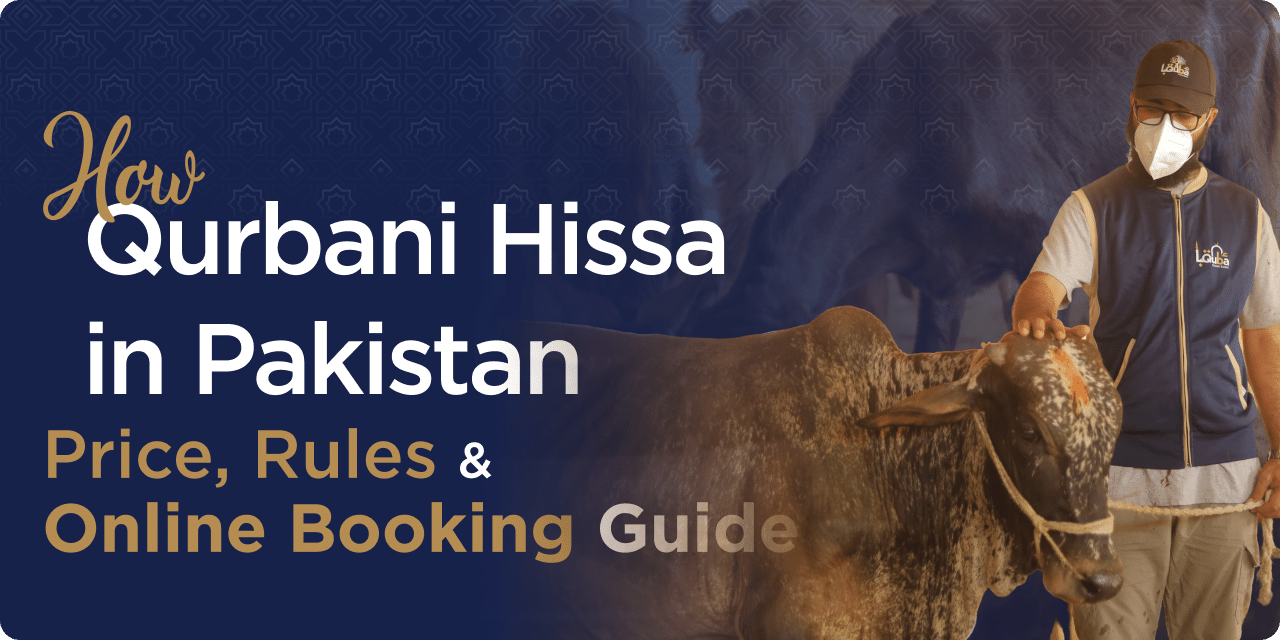
Planning Qurbani this Eid but not sure how cow shares work? Here’s everything you need to know about qurbani hissa in Pakistan.
What is Qurbani Hissa in Islam?
Qurbani hissa is a shared portion of a cow, bull, or camel divided among seven people for Eid ul Adha (also known as qurbani eid). It is one of the most common ways Muslims in Pakistan perform Eid ul Adha. It is also commonly known as cow share qurbani and is widely used in online qurbani services.
How Qurbani Hissa Works
Seven people share one animal, making it easier for individuals who cannot afford or manage a full sacrifice on their own. This system has become especially common in cities like Karachi and Lahore, where shared arrangements are widely practiced among middle-income families.
The total cost of the animal is divided equally among participants, making qurbani more practical and financially manageable. Instead of one person bearing the full expense, each participant contributes their share.
Why It Is Used in Pakistan
In urban areas, keeping a large animal is often not possible due to limited space. For example, managing a 400kg bull in a small apartment is not practical. The shared qurbani model solves this issue while still fulfilling the religious obligation.
Each participant receives the full reward based on sincere intention and halal earnings. With rising livestock prices in Pakistan, qurbani hissa makes Eid sacrifice more accessible and ensures more people can participate without financial pressure.
The Diversity of Sacrifice: Goats, Lambs, and Shares
Is a goat better than a cow share? It really depends on the person and their situation. The tradition of sacrificing a goat or sheep is very personal and widely practiced in Eid ul Adha.
In Islam, a small animal like a goat or ram counts as one complete sacrifice for one person, similar to how the Prophet ﷺ used to sacrifice two rams. Many people still prefer the hands-on experience of qurbani. They go to the mandi, choose the animal themselves, and arrange the sacrifice personally. That emotional connection is something a shared system like cow share qurbani or eid cow qurbani does not always provide.
The rules of qurbani are strict and must be followed carefully. A goat must be at least one year old, a cow at least two years old, and a camel at least five years old. If an animal is too young or has a clear defect, the sacrifice may not be valid.
Because of these options, people choose what best fits their financial and practical situation. Some families even combine both approaches. They keep a goat at home for a more personal experience and also participate in a qurbani hissa (cow share) so that meat can reach remote and needy communities. This creates a balanced way of keeping the tradition alive while maximizing impact.
Eid ul Adha and Its Significance in Pakistan
In Pakistan, things change quickly once the moon of Dhul Hijjah is sighted. There is a strong mix of religious preparation and practical arrangements at the same time. Rising animal prices also make the situation difficult for many families. Fodder, transport, and overall livestock costs have increased significantly, so whether someone is performing qurbani individually or through a system like qurbani hissa, it affects almost everyone.
Eid ul Adha is a reminder of Prophet Ibrahim’s devotion and complete submission to Allah. In Pakistan, people express this spirit through sacrifice and charity. At the same time, modern city life has changed how qurbani is managed. Many people with busy jobs cannot handle an animal for several days, and even the cleaning and logistics can be exhausting.
This is why shared qurbani and cow share qurbani options have become common in urban areas. They reduce the physical burden while allowing people to focus more on the spiritual purpose of Eid ul Adha.
Benefits of Online Qurbani in Pakistan
If you have ever visited a bakra mandi in peak heat, you know how tiring the experience can be. The dust, noise, and constant bargaining can quickly become overwhelming. Because of this, many people in Pakistan now prefer online qurbani services. It offers a more organized and stress-free way to manage qurbani. You can easily book a cow share from your phone while sitting at home or at work, which makes the entire process much more convenient.
One of the biggest advantages is clear and fixed pricing; users prefer systems like eid cow qurbani and online qurbani Pakistan platforms. In traditional mandis, prices can change depending on timing, demand, and negotiation. Online qurbani Pakistan platforms usually offer fixed rates, which removes uncertainty and last-minute price shocks.
For overseas Pakistanis living in places like New York, London, or Dubai, this system is even more useful. They can arrange their qurbani hissa or cow share qurbani in Pakistan for their families or for charitable distribution, knowing the process is handled properly and transparently. It is a simple and modern way to fulfill an important religious tradition.
What is Waqf Qurbani and Its Spiritual Depth
Waqf qurbani means donating the entire share without keeping any portion for personal use. It is intended for those who prefer to give their sacrifice entirely to people in need.
This form of qurbani is especially impactful in regions such as Tharparkar and parts of Balochistan, where access to fresh meat is limited. Many families receive meat only once a year or less.
Organizations handling waqf qurbani, including trusted platforms like Quba Foundation, ensure proper preparation, hygienic packaging, and respectful distribution. The focus is not only on food delivery but also on maintaining dignity for recipients, reflecting the spirit of sunnah and social responsibility.
Socio-Economic Impact and Rural Livelihoods
Qurbani is not only a religious practice; it also plays an important role in Pakistan’s economy. A significant amount of money circulates through the livestock market in a short period during Eid. This seasonal demand supports rural families who depend on raising animals throughout the year. For many small farmers, livestock is their primary source of income, and Eid sales help them meet essential expenses such as education, healthcare, and household needs.
The impact extends to other industries as well. The leather sector relies heavily on animal hides collected during qurbani, which are processed and exported. This contributes foreign exchange to the economy and supports industrial activity. In this way, qurbani creates an economic chain that connects farmers, traders, and industrial workers, linking multiple sectors in a way that is often overlooked.
Ethical Standards and Animal Welfare in Sacrifice
A sacrifice is only meaningful if the animal is treated properly. In Islam, compassion is very important. Animals should be given water, shade, and a calm environment. A sharp knife must be used, and one animal should not be slaughtered in front of another. If these basic principles are ignored, it affects the spirit of the act, even if the sacrifice itself still counts.
Many organized services now focus more on animal welfare. They use trained people who understand how to handle animals with care and responsibility. Choosing a reliable service helps ensure these standards are followed. It also keeps the process more respectful and organized. When animals are handled properly, the process becomes smoother and more dignified for everyone involved.
The Practical Shift to Centralized Services
Keeping animals in streets and neighborhoods is becoming less common in crowded urban areas. In cities, it is often difficult to manage due to space and sanitation issues. Because of this, centralized qurbani centers are now more common. People book their share through a foundation, and the organization handles everything at a proper facility.
This approach is more practical for city life and helps keep the surroundings cleaner. For people living in apartments or gated communities, it is often the easier option. It still follows the same religious practice, but in a more organized way. It also helps in distributing meat more fairly, so it can reach areas where people are in greater need instead of only nearby neighborhoods.
The Role of Sincerity in Shared Sacrifice
At the end of the day, what matters most is intention. Even if a cow is shared among seven people, each person’s reward is based on their own sincerity. It is important that everyone involved has a genuine purpose. Some scholars mention that if the intention of one participant is not serious, it can affect the overall act, which is why people often prefer trusted and organized arrangements. These foundations help bring together individuals who are genuinely committed to fulfilling the sacrifice properly.
This shared responsibility also creates a sense of connection. People from different backgrounds take part in the same act of worship, which reflects unity within the community. In this way, each share becomes part of a larger act of devotion and service.
Logistics and the Cold Chain in Meat Distribution
In hot weather, fresh meat can spoil quickly, especially during a Pakistani summer. Because of this, organized systems have an advantage. Many professional setups now use refrigerated transport and proper storage methods to keep meat safe until delivery. This is a major improvement compared to older methods where transport was more basic and open.
To maintain quality, insulated containers and cooling methods like ice packs are used so the meat stays fresh even during long-distance delivery to rural areas. This kind of planning helps ensure the process runs smoothly from start to finish. When handling is done properly, more of the sacrifice benefits reach the people who need it most.
Transparency and Reporting for Donors
Trust has to be earned. Today, donors want clear updates on where their contribution goes. Many reputable organizations, including Quba Foundation, now share photos of the animal and the distribution process. Some also provide digital updates so people can follow their qurbani more easily. This makes the process clearer and more connected.
It no longer feels like just a payment. It becomes something more real and meaningful. When people see photos of families receiving the meat, it builds trust and emotional connection. Transparency helps organizations stay accountable and also encourages people to continue supporting such efforts. In the end, it creates a system based on honesty and visible impact.
Global Reach and the Diaspora Connection
The Pakistani diaspora plays a major role in this process. Millions of people living abroad choose to arrange their qurbani in Pakistan because the need is greater and their contribution goes further. Online platforms have made this very simple. Someone in London or New York can support a family or community in Pakistan with just a few clicks.
This flow of support helps direct resources to places where they are needed most, while also keeping people connected to their roots. It creates a sense of shared responsibility that goes beyond borders. In the end, it reflects the idea that helping others is a duty that continues no matter where someone lives.
Conclusion: The Spirit of Excellence and Responsibility
Eid is approaching, and the focus is on ihsan, which means doing things with excellence. Whether someone chooses a goat or a shared portion, what matters most is doing it with care and responsibility. The tradition should be respected, while also using modern systems to make the process more organized and easier to manage.
In the end, whether it is a personal sacrifice or a waqf donation, sincerity matters most. Choosing trustworthy arrangements helps keep the practice meaningful and well-managed. It is a reminder to act responsibly and use this time to strengthen both faith and community through giving.
If you are planning your qurbani this year, understanding how qurbani hissa works can help you make a more informed decision.
Many people now prefer organized and transparent services so their sacrifice is handled properly and reaches those in need.
Whether you choose a personal sacrifice or a shared qurbani hissa, what matters most is intention and doing it with care. Understanding how qurbani hissa works makes qurbani eid easier, more organized, and more accessible for everyone.
Frequently Asked Questions
FAQ's
Seven people share one cow
Yes. One share is considered equivalent to a full goat sacrifice.
At least two years old.
At least one year old.
It means the entire share is donated, and nothing is kept for personal use.